07 July 2022

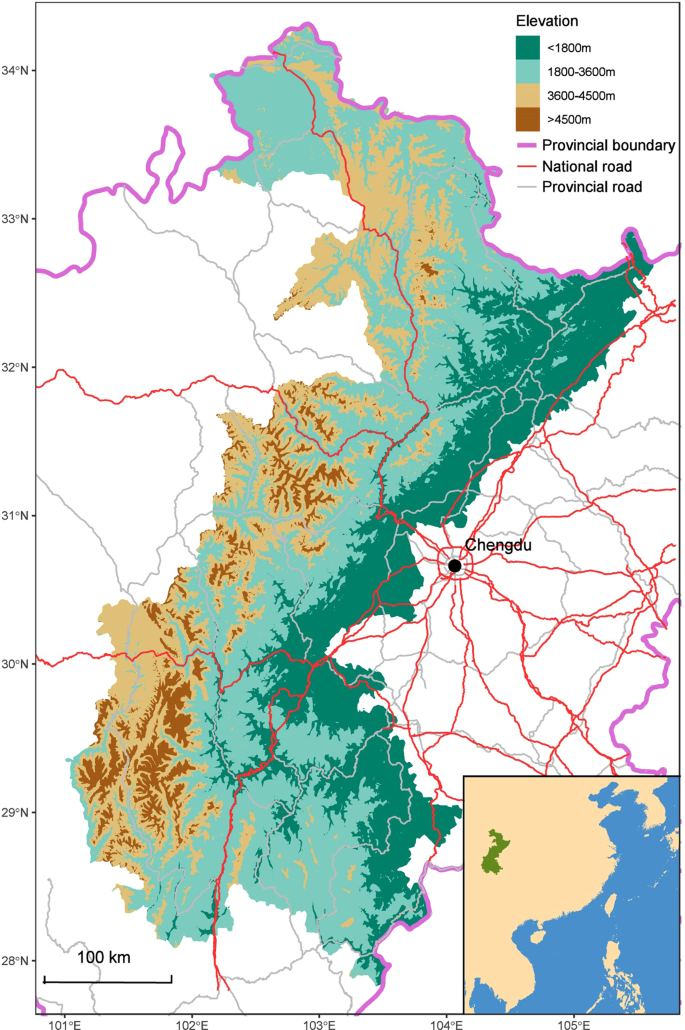
Effects of roads on giant panda distribution: a mountain range scale evaluation

figure 1


Abstract: "Few studies have focused on the mountain ranges scale effects of roads on wildlife. This lack of data could lead to an underestimation of the negative impact of roads on animal populations. We analyzed a dataset that included 74.4% of the giant panda population and covered 78.7% of the global giant panda habitat to estimate road-effect zones for major roads, and to investigate how these major roads influenced the distribution of giant pandas on a mountain range spatial scale. We found that the density of giant panda signs was significantly decreased by proximity to major roads. The effect zone reached 5,000 m from national roads and 1,500 m from provincial roads. Structural equation model analysis revealed that the strongest negative impact of major roads on giant pandas was via the reduction of nearby forest cover. The results should provide a better understanding of the impact of anthropogenic infrastructure and regional economic development on wildlife, thus providing a basis for conservation policy decisions. We suggest that the environmental impact assessment of proposed roadways or further researches on road ecological effects should expand to a larger scale and consider the possible habitat degradation caused by road access."

Read More: https://www.nature.com/articles/s41598-018-37447-0

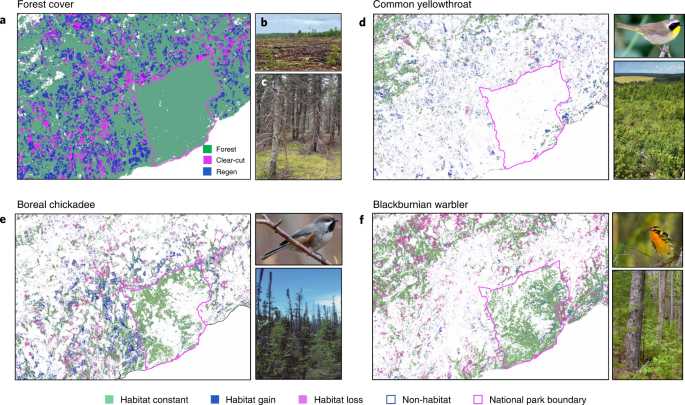
Forest degradation drives widespread avian habitat and population declines

figure 2


Abstract: "In many regions of the world, forest management has reduced old forest and simplified forest structure and composition. We hypothesized that such forest degradation has resulted in long-term habitat loss for forest-associated bird species of eastern Canada (130,017 km2) which, in turn, has caused bird-population declines. Despite little change in overall forest cover, we found substantial reductions in old forest as a result of frequent clear-cutting and a broad-scale transformation to intensified forestry. Back-cast species distribution models revealed that breeding habitat loss occurred for 66% of the 54 most common species from 1985 to 2020 and was strongly associated with reduction in old age classes. Using a long-term, independent dataset, we found that habitat amount predicted population size for 94% of species, and habitat loss was associated with population declines for old-forest species. Forest degradation may therefore be a primary cause of biodiversity decline in managed forest landscapes."

Read More: https://www.nature.com/articles/s41559-022-01737-8

02 February 2022

For the Year of the Tiger, a shared vision for the future of the iconic cat (commentary)

Abstract: "As the Year of the Tiger begins on February 1, a coalition of six top NGOs is committing to a cooperative approach to save the iconic big cat. In the past 12 years, tigers increased significantly in some areas but disappeared from others: a close assessment of these trends is key in advance of the next Global Tiger summit in September 2022. The authors from IUCN, FFI, WCS, WWF, Traffic and Panthera argue that ambition must increase but also that funders must support collaborative efforts instead of the status quo/competitive model of funding conservation."

Read More: https://news.mongabay.com/2022/01/for-the-year-of-the-tiger-a-shared-vision-for-the-future-of-the-iconic-cat-commentary/

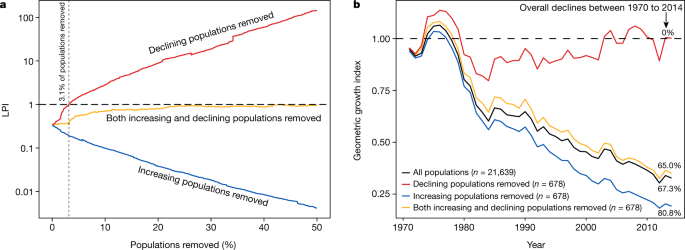
Emphasizing declining populations in the Living Planet Report

figure 1

Summary: "The Living Planet Report, which has been published biannually since 1998, is key for understanding trends in wildlife populations and promoting sound conservation. Leung et al. recently disagreed with the conclusions of the Living Planet Report and found that the overall pattern of population declines stems from very few populations (extreme clusters), beyond which global vertebrate populations are not declining. However, when properly accounting also for the influence of the fastest-increasing populations, we find that the overall declines in the Living Planet Report are practically unchanged. Moreover, the Living Planet Database is heavily biased towards populations that receive more conservation attention, indicating that the true population trends are indeed dire and may actually be worse than depicted in the Living Planet Report.

Read more: https://www.nature.com/articles/s41586-021-04165-z

27 December 2021

Edward O. Wilson, prominent biologist and author, has died at 92

E. O. Wilson in 2003. Photo credit: Jim Harrison / PLOS

Abstract: "Edward O. Wilson, a prominent biologist and prolific author who help raise global awareness and understanding about biodiversity and conservation, has died. Wilson began his career studying the biology and social structures of ants which led him to develop expansive theories on evolution and humanity’s relationship with the planet. While Wilson’s research was highly influential in scientific circles and won numerous recognitions, he was mostly widely known for his accessible writing, including articles and best-selling books which introduced concepts like biodiversity to the masses. Wilson was an outspoken advocate for global conservation efforts."

Read more:  https://news.mongabay.com/2021/12/edward-o-wilson-prominent-biologist-and-author-has-died-at-92/

17 December 2021

‘Cooling the climate for 10,000 years’: How saving wetlands can help save the world

A cloudberry ripe for the picking in a Scandinavian bog. Image in the public domain.


ABSTRACT: "From the vast frozen mires of the arctic to the peat swamps of Asia: “all wetlands are under threat,” said Jane Madgwick, CEO of Wetlands International. “We’re losing them three times as fast as forests." Peat swamps, or peatlands, are particularly effective at storing carbon, which has accumulated over centuries and even millennia as dead plant matter became trapped in waterlogged soil. But if drained or otherwise damaged, peat quickly turns from carbon sink to carbon source. As nations race to protect and replant forests in an effort to curtail global warming, wetlands experts such as Madgwick are urging leaders to place similar importance on wetland conservation and restoration.


READ MORE: https://news.mongabay.com/2021/12/cooling-the-climate-for-10000-years-how-saving-wetlands-can-help-save-the-world/


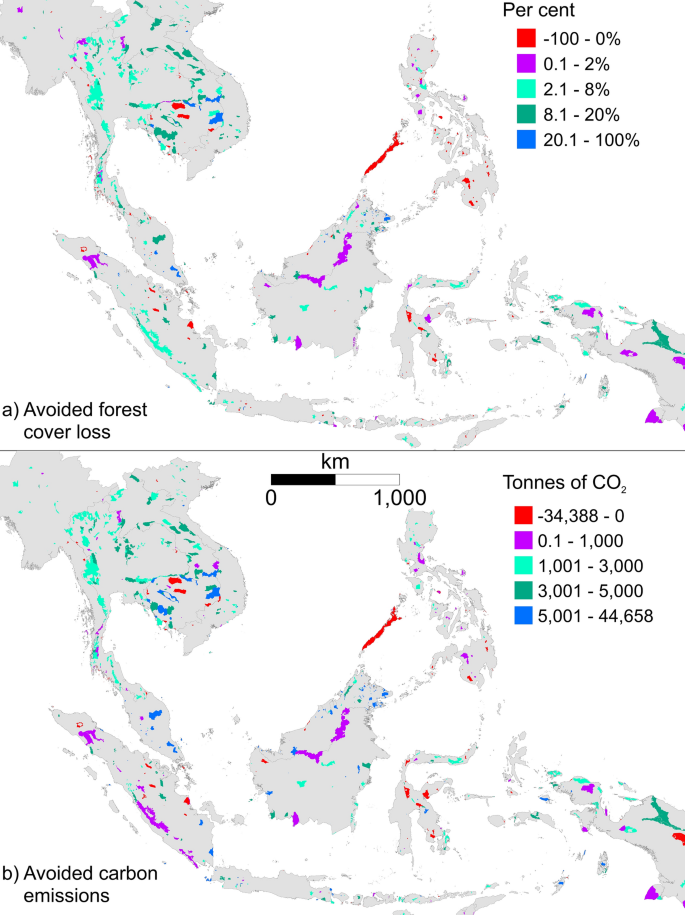
Southeast Asian protected areas are effective in conserving forest cover and forest carbon stocks compared to unprotected areas

figure1


ABSTRACT: "Protected areas aim to conserve nature, ecosystem services, and cultural values; however, they have variable success in doing so under high development pressure. Southeast Asian protected areas faced the highest level of human pressure at the turn of the twenty-first century. To estimate their effectiveness in conserving forest cover and forest carbon stocks for 2000–2018, we used statistical matching methods to control for the non-random location of protected areas, to compare protection against a matched counterfactual. We found Southeast Asian protected areas had three times less forest cover loss than similar landscapes without protection. Protected areas that had completed management reporting using the Management Effectiveness Tracking Tool (METT) conserved significantly more forest cover and forest carbon stocks than those that had not. Management scores were positively associated with the level of carbon emissions avoided, but not the level of forest cover loss avoided. Our study is the first to find that METT scores could predict the level of carbon emissions avoided in protected areas. Given that only 11% of protected areas in Southeast Asia had completed METT surveys, our results illustrate the need to scale-up protected area management effectiveness reporting programs to improve their effectiveness for conserving forests, and for storing and sequestering carbon."

READ MORE: https://www.nature.com/articles/s41598-021-03188-w