30 November 2017

Climate Science Special Report: Fourth National Climate Assessment (NCA4), Volume I

Climate Science Special Report

Fourth National Climate Assessment (NCA4), Volume This report is an authoritative assessment of the science of climate change, with a focus on the United States. It represents the first of two volumes of the Fourth National Climate Assessment, mandated by the Global Change Research Act of 1990.


"Since NCA3, stronger evidence has emerged for continuing, rapid, human-caused warming of the global atmosphere and ocean. This report concludes that:


'it is extremely likely that human influence has been the dominant cause of the observed warming since the mid-20th century. For the warming over the last century, there is no convincing alternative explanation supported by the extent of the observational evidence.'

New observations and new research have increased our understanding of past, current, and future climate change since the Third U.S. National Climate Assessment (NCA3) was published in May 2014. This Climate Science Special Report (CSSR) is designed to capture that new information and build on the existing body of science in order to summarize the current state of knowledge and provide the scientific foundation for the Fourth National Climate Assessment (NCA4).”


Read more or download at: https://science2017.globalchange.gov/

10 November 2017

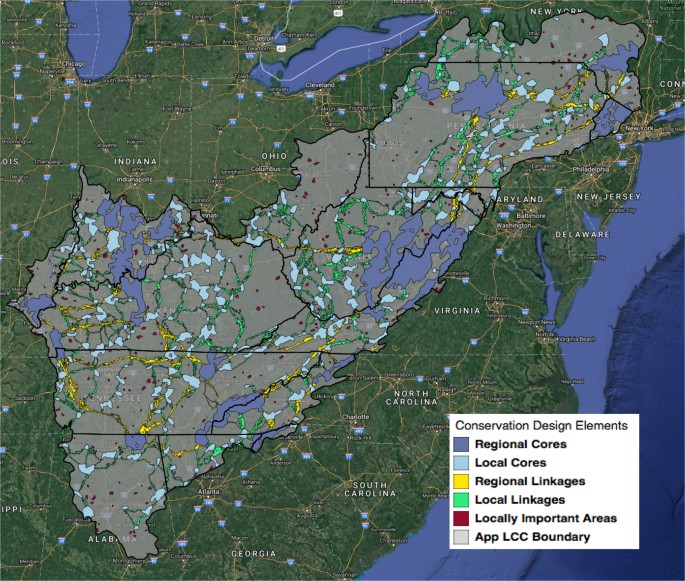
Landscape-scale Conservation Design Across Biotic Realms: Sequential Integration of Aquatic and terrestrial Landscapes

Figure 2


Abstract:

"Systematic conservation planning has been used extensively throughout the world to identify important areas for maintaining biodiversity and functional ecosystems, and is well suited to address large-scale biodiversity conservation challenges of the twenty-first century. Systematic planning is necessary to bridge implementation, scale, and data gaps in a collaborative effort that recognizes competing land uses. Here, we developed a conservation planning process to identify and unify conservation priorities around the central and southern Appalachian Mountains as part of the Appalachian Landscape Conservation Cooperative (App LCC). Through a participatory framework and sequential, cross-realm integration in spatial optimization modeling we highlight lands and waters that together achieve joint conservation goals from LCC partners for the least cost. This process was driven by a synthesis of 26 multi-scaled conservation targets and optimized for simultaneous representation inside the program Marxan to account for roughly 25% of the LCC geography. We identify five conservation design elements covering critical ecological processes and patterns including interconnected regions as well as the broad landscapes between them. Elements were then subjected to a cumulative threats index for possible prioritization. The evaluation of these elements supports multi-scaled decision making within the LCC planning community through a participatory, dynamic, and iterative process."


Read more: https://www.nature.com/articles/s41598-017-15304-w

03 November 2017

Researchers Verify New Orangutan Species

Large image of Figure 1.


Abstract:

"Six extant species of non-human great apes are currently recognized: Sumatran and Bornean orangutans, eastern and western gorillas, and chimpanzees and bonobos [1]. However, large gaps remain in our knowledge of fine-scale variation in hominoid morphology, behavior, and genetics, and aspects of great ape taxonomy remain in flux. This is particularly true for orangutans (genus: Pongo), the only Asian great apes and phylogenetically our most distant relatives among extant hominids [1]. Designation of Bornean and Sumatran orangutans, P. pygmaeus (Linnaeus 1760) and P. abelii (Lesson 1827), as distinct species occurred in 2001 [1, 2]. Here, we show that an isolated population from Batang Toru, at the southernmost range limit of extant Sumatran orangutans south of Lake Toba, is distinct from other northern Sumatran and Bornean populations. By comparing cranio-mandibular and dental characters of an orangutan killed in a human-animal conflict to those of 33 adult male orangutans of a similar developmental stage, we found consistent differences between the Batang Toru individual and other extant Ponginae. Our analyses of 37 orangutan genomes provided a second line of evidence. Model-based approaches revealed that the deepest split in the evolutionary history of extant orangutans occurred ∼3.38 mya between the Batang Toru population and those to the north of Lake Toba, whereas both currently recognized species separated much later, about 674 kya. Our combined analyses support a new classification of orangutans into three extant species. The new species, Pongo tapanuliensis, encompasses the Batang Toru population, of which fewer than 800 individuals survive."


Read More: http://www.cell.com/current-biology/fulltext/S0960-9822(17)31245-9

02 November 2017

Creation of Forest Edges has a Global Impact on Forest Vertebrates


Forest occupancy and edge sensitivities for forest-core species.


Abstract:

"Forest edges influence more than half of the world’s forests and contribute to worldwide declines in biodiversity and ecosystem functions. However, predicting these declines is challenging in heterogeneous fragmented landscapes. Here we assembled a global dataset on species responses to fragmentation and developed a statistical approach for quantifying edge impacts in heterogeneous landscapes to quantify edge-determined changes in abundance of 1,673 vertebrate species. We show that the abundances of 85% of species are affected, either positively or negatively, by forest edges. Species that live in the centre of the forest (forest core), that were more likely to be listed as threatened by the International Union for Conservation of Nature (IUCN), reached peak abundances only at sites farther than 200–400 m from sharp high-contrast forest edges. Smaller-bodied amphibians, larger reptiles and medium-sized non-volant mammals experienced a larger reduction in suitable habitat than other forest-core species. Our results highlight the pervasive ability of forest edges to restructure ecological communities on a global scale."


Read More: https://www.nature.com/nature/journal/vaop/ncurrent/full/nature24457.html#author-information


26 October 2017

Reductions in Global Biodiversity Loss Predicted from Conservation Spending

Country-scale Rate of Biodiversity Decline (BDS) Depends on Conservation Spending Levels:


Abstract:

"Halting global biodiversity loss is central to the Convention on Biological Diversity and United Nations Sustainable Development Goals, but success to date has been very limited. A critical determinant of success in achieving these goals is the financing that is committed to maintaining biodiversity; however, financing decisions are hindered by considerable uncertainty over the likely impact of any conservation investment. For greater effectiveness, we need an evidence-based model that shows how conservation spending quantitatively reduces the rate of biodiversity loss. Here we demonstrate such a model, and empirically quantify how conservation investment between 1996 and 2008 reduced biodiversity loss in 109 countries (signatories to the Convention on Biological Diversity and Sustainable Development Goals), by a median average of 29% per country. We also show that biodiversity changes in signatory countries can be predicted with high accuracy, using a dual model that balances the effects of conservation investment against those of economic, agricultural and population growth (human development pressures). Decision-makers can use this model to forecast the improvement that any proposed biodiversity budget would achieve under various scenarios of human development pressure, and then compare these forecasts to any chosen policy target. We find that the impact of spending decreases as human development pressures grow, which implies that funding may need to increase over time. The model offers a flexible tool for balancing the Sustainable Development Goals of human development and maintaining biodiversity, by predicting the dynamic changes in conservation finance that will be needed as human development proceeds."


Read More: https://www.nature.com/nature/journal/vaop/ncurrent/full/nature24295.html

24 October 2017

Half-Earth Day Celebrated on 23 October 2017


Monday, October 23, marked the first-ever Half-Earth Day.  The E.O. Wilson Biodiversity Foundation and National Geographic timed the event to occur exactly half a year after Earth Day (April 22). But Half-Earth Day also gets its name from the biodiversity conservation initiative spearheaded by renowned biologist and conservationist Edward O. Wilson, discussed in his 2016 book, Half-Earth: Our Planet’s Fight for Life. Wilson’s idea, which is backed up by research, is that we can protect 85 percent of Earth’s biodiversity by conserving half of the world’s land and seas.

“The Half-Earth approach is not only science-based, but it will also expand fundamental science into new directions,” Wilson, who is a research professor emeritus at Harvard, said in a statement. “The goal of discovering and mapping all biodiversity, and especially at the level of species, will lead to immense new knowledge in basic and applied biology.”


“Our planet is at a crossroads, and there is both an opportunity and a critical need to act now, and to do so boldly,” Gary E. Knell, president and CEO of the National Geographic Society, said in a statement. “National Geographic is proud to convene the first-ever Half-Earth Day to inspire people everywhere to understand and care for our world, furthering our progress toward a healthier and more sustainable future for generations to come.”


Read More: https://news.mongabay.com/2017/10/half-earth-day-to-be-celebrated-next-week/

20 October 2017

New analysis suggests that preserving rare species is vital to tropical forests

tropical forest


In a paper published Oct. 18 in the journal Science Advances, scientists report that a new method allows us to understand both how fragile the biodiversity is and how many species we should be focusing on with conservation efforts. “As caretakers of this planet, we want to nurture the species that we have, and we want to preserve life for the next generation.”


Read More: http://gearsofbiz.com/new-analysis-suggests-that-preserving-rare-species-is-vital-to-tropical-forests/139054