25 May 2019

Projected losses of global mammal and bird ecological strategies

figure1


Abstract: "Species, and their ecological strategies, are disappearing. Here we use species traits to quantify the current and projected future ecological strategy diversity for 15,484 land mammals and birds. We reveal an ecological strategy surface, structured by life-history (fast–slow) and body mass (small–large) as one major axis, and diet (invertivore–herbivore) and habitat breadth (generalist–specialist) as the other. We also find that of all possible trait combinations, only 9% are currently realized. Based on species’ extinction probabilities, we predict this limited set of viable strategies will shrink further over the next 100 years, shifting the mammal and bird species pool towards small, fast-lived, highly fecund, insect-eating, generalists. In fact, our results show that this projected decline in ecological strategy diversity is much greater than if species were simply lost at random. Thus, halting the disproportionate loss of ecological strategies associated with highly threatened animals represents a key challenge for conservation."


Read More: https://www.nature.com/articles/s41467-019-10284-z


15 May 2019

Loss of forest elephant may make Earth ‘less inhabitable for humans’

Elephants drink roughly 200 liters (50 gallons) of water each day. In Zimbabwe's Hwange National Park, they come together at waterholes such as this one during the region's dry season (August through October).


Abstract: "A new review paper finds that the loss of Africa’s forest elephants has broad impacts on their ecosystems, including hitting several tall tree species, which play a key role in sequestering carbon dioxide. Forest elephants disperse large seeds, keep the forest canopy open, and spread rare nutrients across the forest, benefiting numerous species across the African tropics. While the IUCN currently defines African elephants as a single species, scientists believe it long past time to split them into two distinct species, savanna and forest, to bolster protection for both from the ivory trade."


Read more: https://news.mongabay.com/2018/10/loss-of-forest-elephant-may-make-earth-less-inhabitable-for-humans/


14 May 2019

’Unprecedented’ loss of biodiversity threatens humanity, report finds


Abstract: "The U.N.’s Intergovernmental Science-Policy Platform on Biodiversity and Ecosystem Services released a summary of far-reaching research on the threats to biodiversity on May 6. The findings are dire, indicating that around 1 million species of plants and animals face extinction. The full 1,500-page report, to be released later this year, raises concerns about the impacts of collapsing biodiversity on human well-being."


Read More: https://news.mongabay.com/2019/05/unprecedented-loss-of-biodiversity-threatens-humanity-report-finds/

Study finds elephants plant trees, play big role in forest structure


Abstract: "Many large animals – collectively called “megafauna” – eat the fruit of Platymitra macrocarpa trees, including Asian elephants (Elephas maximus), sambar deer (Rusa unicolor), bears and gibbons. When researchers examined the fruit consumption, seed dispersal, and seed germination trends of P macrocarpa, they discovered that elephants were responsible for the lion’s share of successful seedling germination – 37 percent – despite consuming only 3 percent of available fruit. They also noticed a decline in P macrocarpa, which they say may be due to extirpated rhinos or reductions in local elephant populations. They say their results highlight the important role large herbivores play in forest structure, and that losses of these animals might significantly change tree composition and even a forest’s ability to store carbon."


Read More: https://news.mongabay.com/2018/07/study-finds-elephants-plant-trees-play-big-role-in-forest-structure/

New study suggests Borneo’s had elephants for thousands of years


Abstract: "The research, published in January in the journal Scientific Reports, used genetic information and changes to the topography of the region to surmise that Asian elephants arrived in Borneo between 11,000 and 18,000 years ago.The authors hypothesize that elephants moved from nearby islands or the Malaysian peninsula to Borneo via land bridges. It’s an indication that the elephants are ‘native’ to Borneo, the scientists argue, and points to the need to bolster conservation efforts."


Read More: https://news.mongabay.com/2018/01/new-study-suggests-borneos-had-elephants-for-thousands-of-years-2/

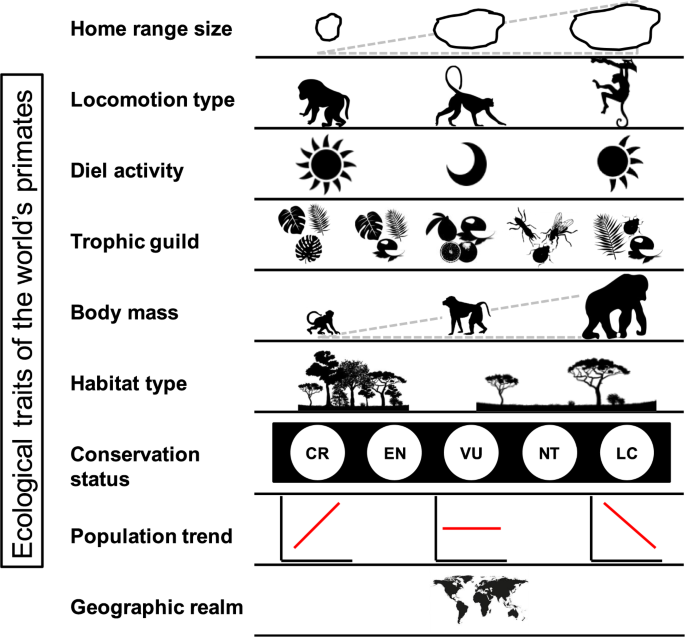
Ecological traits of the world’s primates

Figure 1


Abstract: "Ecosystems largely depend, for both their functioning and their ecological integrity, on the ecological traits of the species that inhabit them. Non-human primates have a wide geographic distribution and play vital roles in ecosystem structure, function, and resilience. However, there is no comprehensive and updated compilation of information on ecological traits of all the world’s primate species to accurately assess such roles at a global scale. Here we present a database on some important ecological traits of the world’s primates (504 species), including home range size, locomotion type, diel activity, trophic guild, body mass, habitat type, current conservation status, population trend, and geographic realm. We compiled this information through a careful review of 1,216 studies published between 1941 and 2018, resulting in a comprehensive, easily accessible and user-friendly database. This database has broad applicability in primatological studies, and can potentially be used to address many research questions at all spatial scales, from local to global."


Read More: https://www.nature.com/articles/s41597-019-0059-9


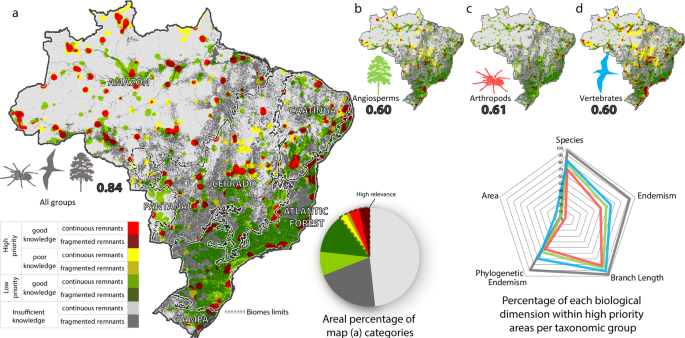
Modelling Highly Biodiverse Areas in Brazil

Figure 2


Abstract: "Traditional conservation techniques for mapping highly biodiverse areas assume there to be satisfactory knowledge about the geographic distribution of biodiversity. There are, however, large gaps in biological sampling and hence knowledge shortfalls. This problem is even more pronounced in the tropics. Indeed, the use of only a few taxonomic groups or environmental surrogates for modelling biodiversity is not viable in mega-diverse countries, such as Brazil. To overcome these limitations, we developed a comprehensive spatial model that includes phylogenetic information and other several biodiversity dimensions aimed at mapping areas with high relevance for biodiversity conservation. Our model applies a genetic algorithm tool for identifying the smallest possible region within a unique biota that contains the most number of species and phylogenetic diversity, as well as the highest endemicity and phylogenetic endemism. The model successfully pinpoints small highly biodiverse areas alongside regions with knowledge shortfalls where further sampling should be conducted. Our results suggest that conservation strategies should consider several taxonomic groups, the multiple dimensions of biodiversity, and associated sampling uncertainties."


Read More: https://www.nature.com/articles/s41598-019-42881-9