14 October 2017

Climate Change & Anthropocene Extinction 23: Amazon ‘tipping point’ is a sliding process, from +1C

carbon climate feedbacks prompting 2015 CO2 emissions record


The Amazon rainforest is seriously threatened by climate change. The Amazon is referred to as a climate tipping point because research shows following a 21st century global average temperature rise most of the Amazon basin may dry out, leading to a massive biome shift – accompanied by many gigatonnes of extra CO2 emissions and almost unimaginable biodiversity loss, placing the cascading Anthropocene Extinction in top gear.


Read More: http://www.bitsofscience.org/climate-change-amazon-tipping-point-7540/

Diversity of Large animals Plays an Important Role in Carbon Cycle

Trees in tropical forests are well known for removing carbon dioxide from the air and storing the potent greenhouse gas as carbon in their leafy branches and extensive roots. But a new analysis led by Stanford University researchers finds that large forest animals are also an important part of the carbon cycle.

The findings are based on more than a million records of animal sightings and activity collected by 340 indigenous technicians in the Amazon during more than three years of environmental surveys, coordinated by ecologist Jose Fragoso and supported by biologist Rodolfo Dirzo, who were working together at Stanford at the time. The team found that places where animals are most diverse correlate with places that have the most carbon sequestered in the soil.


<iframe src="https://player.vimeo.com/video/218616392" width="640" height="360" frameborder="0" webkitallowfullscreen mozallowfullscreen allowfullscreen>>


Read more at: https://phys.org/news/2017-10-diversity-large-animals-important-role.html

Business Owners in Top Belize Destination Want Increased Mangrove Protections


Loss of mangroves on land is a threat to clean water and healthy reefs. A number of business owners would like to see better mangrove protections and planning documents developed. Up to one third of Belize citizens work in the tourism sector, more than agriculture.


Read More: https://news.mongabay.com/2017/07/top-belize-destination-divided-over-mangrove-conservation/

06 October 2017

Biodiversity of Indian Sunderbans Recorded for the First time


Zoological Survey of India has, for the first time, published a detailed record of the animal and protozoa species of the Sunderban of West Bengal. Sunderbans forests, locally known as Badabon, are one of the richest biodiversity hotspots in India. This UNESCO World Heritage site is known for its mangroves, coastal forests that serve as a biological buffer between the land and sea. This unique ecosystem is famous for the royal Bengal tiger, Gangetic dolphin, and estuarine crocodile.


Read More: https://news.mongabay.com/2017/10/biodiversity-of-indian-sunderbans-recorded-for-the-first-time/

05 October 2017

Quantifying the Evidence for Co-Benefits Between Species Conservation and Climate Change Mitigation in Giant Panda Habitats


Abstract: "Conservationists strive for practical, cost-effective management solutions to forest-based species conservation and climate change mitigation. However, this is compromised by insufficient information about the effectiveness of protected areas in increasing carbon storage, and the co-benefits of species and carbon conservation remain poorly understood. Here, we present the first rigorous quantitative assessment of the roles of giant panda nature reserves (NRs) in carbon sequestration, and explore the co-benefits of habitat conservation and climate change mitigation. Results show that more than 90% of the studied panda NRs are effective in increasing carbon storage, with the mean biomass carbon density of the whole NRs exhibiting a 4.2% higher growth rate compared with lands not declared as NRs over the period 1988–2012, while this effectiveness in carbon storage masks important patterns of spatial heterogeneity across the giant panda habitats. Moreover, the significant associations have been identified between biomass carbon density and panda’s habitat suitability in ~85% NRs and at the NR level. These findings suggest that the planning for carbon and species conservation co-benefits would enhance the greatest return on limited conservation investments, which is a critical need for the giant panda after its conservation status has been downgraded from “endangered” to “vulnerable”.
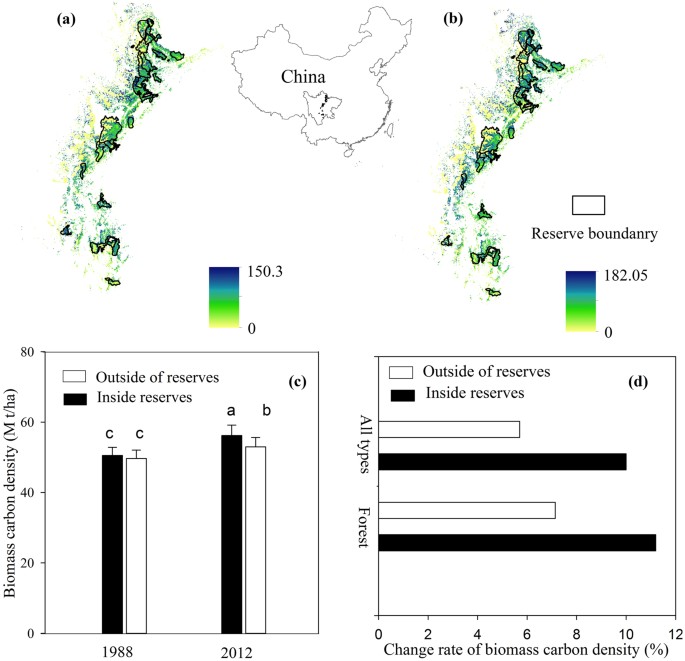

Figure 3


"Spatial variation of biomass carbon density (t C ha−1) in giant panda reserves and the matched sites outside of the reserves in (a) 1988 and (b) 2012. (c) Pairwise comparisons of mean biomass carbon density inside and outside the reserves (Error bars represent standard errors). (d) Relative change rate of mean biomass carbon density between 1988 and 2012 inside and outside of nature reserves for the lands covered by forest and all land types."


Read More: https://www.nature.com/articles/s41598-017-12843-0

02 October 2017

Ecology: A Global Plan for Nature Conservation

Jaguar (Panthera onca)


The journal Nature reports that an international movement is calling for at least half of the Earth to be allocated for conservation. A global study now reveals that, in many ecoregions, enough habitat exists to reach this goal, and ideas are proposed by the E.W. Wilson Biodiversity Foundation for the next steps needed.


Read More: https://www.nature.com/nature/journal/vaop/ncurrent/full/nature24144.html

Earth May Be Close to 'Threshold of Catastrophe'

Earth May Be Close to 'Threshold of Catastrophe'


A new study reported by the Convention on Biological Diversity indicates that the amount of carbon dioxide that humans will have released into the atmosphere by 2100 may be enough to trigger a sixth mass extinction. The huge spike in CO2 levels over the past century may put the world dangerously close to a "threshold of catastrophe," after which environmental instability and mass die-offs become inevitable, the new mathematical analysis finds.


Read More: https://www.livescience.com/60578-sixth-mass-extinction-may-be-inevitable.html