
A new study published in Scientific Reports, a journal by Nature, shows that community-managed protected areas are often more effectively conserved than protected areas run by outsiders: Researchers compared deforestation
and forest degradation rates in areas of the Peruvian Amazon that were
unprotected to those protected through government and local management. They
found, on average, locally led conservation initiatives proved more
successful in preserving forests than those that are government-managed. The
study adds to mounting evidence that letting local and indigenous
communities officially manage their forests may often be a highly
effective way to conserve them. However, official
recognition of land rights often stands in the way of community-based
conservation initiatives. The researchers urge the process be simplified
so that more indigenous territories can be established and managed by
the people who live in them.
17 September 2017
Local Approaches to Conservation May be the Most Effective

‘Snow white’ giraffes caught on video for the first time
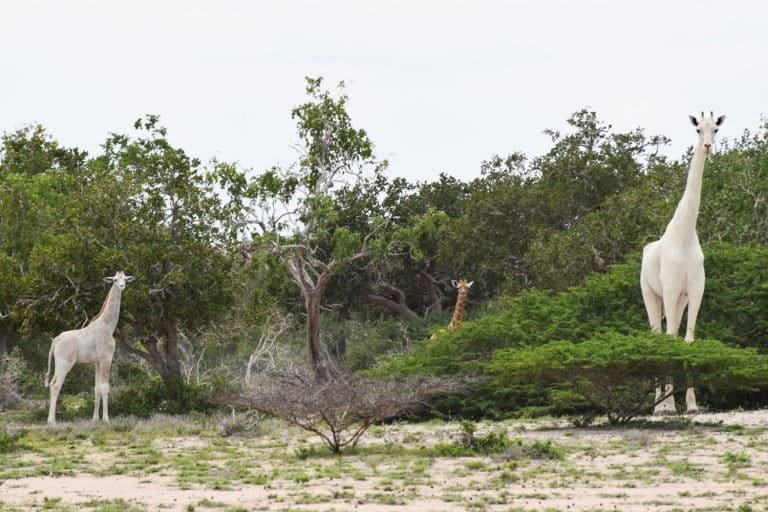
Two rare white giraffes have been captured on video in the wild for the first time, reports a wildlife conservancy in Kenya. The giraffes, which are leucistic, meaning they have a genetic condition that inhibits pigmentation in skin cells rather than albino, or lacking melanin throughout their bodies, were first reported back in June by villagers near the Ishaqbini Hirola Conservancy in Garissa county in northeastern Kenya, according to a blog post from the conservancy.
Read More: https://news.mongabay.com/2017/09/snow-white-giraffes-caught-on-video-for-the-first-time/
30 March 2017
New Study Provides a Blueprint for Engaging Indigenous Peoples in REDD+ Forest Monitoring

It’s been estimated that as much as 10 percent of total global carbon emissions are due to deforestation. And according to an analysis by the World Resources Institute, by securing indigenous land rights in Bolivia, Brazil, and Colombia alone, we could avoid the release of up to 59 megatons of carbon emissions every year — the equivalent of taking 9 to 12 million passenger vehicles off the road.
16 March 2017
Climate change-induced bleaching decimating coral reefs around the world

Rising ocean temperatures are bleaching reefs around the world at unprecedented levels and this coral-killing is unlikely to relent, according to a new study published in the journal Nature.
"During 2015–2016, record temperatures triggered a pan-tropical episode of coral bleaching, the third global-scale event since mass bleaching was first documented in the 1980s. Here we examine how and why the severity of recurrent major bleaching events has varied at multiple scales, using aerial and underwater surveys of Australian reefs combined with satellite-derived sea surface temperatures. The distinctive geographic footprints of recurrent bleaching on the Great Barrier Reef in 1998, 2002 and 2016 were determined by the spatial pattern of sea temperatures in each year. Water quality and fishing pressure had minimal effect on the unprecedented bleaching in 2016, suggesting that local protection of reefs affords little or no resistance to extreme heat. Similarly, past exposure to bleaching in 1998 and 2002 did not lessen the severity of bleaching in 2016. Consequently, immediate global action to curb future warming is essential to secure a future for coral reefs."
Read More: http://www.nature.com/nature/journal/v543/n7645/full/nature21707.html
https://news.mongabay.com/2017/03/climate-change-induced-bleaching-decimating-great-barrier-reef/
08 March 2017
Significant biodiversity remains undiscovered in Borneo's moss forests

Untold numbers of organisms still await discovery among the poorly explored moss forests of Borneo's mountaintops. Near the summit of Gunung Murud (the highest mountain in Sarawak), an undescribed species of tiny bush frog (Philautus sp.) perches inside the pitcher of Nepenthes hurrelliana, a carnivorous plant. Although many frogs utilize the fluid-filled pitchers of various Nepenthes for either shelter or breeding, the details of this behavior remain poorly studied. Are the frogs dependent on the pitchers? Do the plants gain any benefit from this relationship or is this merely an example of the frogs exploiting a convenient niche?
01 March 2017
Earliest evidence of life on Earth discovered with highly significant implications. Report in journal Nature

Abstract: "Although it is not known when or where life on Earth began, some of the earliest habitable environments may have been submarine-hydrothermal vents. Here we describe putative fossilized microorganisms that are at least 3,770 million and possibly 4,280 million years old in ferruginous sedimentary rocks, interpreted as seafloor-hydrothermal vent-related precipitates, from the Nuvvuagittuq belt in Quebec, Canada. These structures occur as micrometre-scale haematite tubes and filaments with morphologies and mineral assemblages similar to those of filamentous microorganisms from modern hydrothermal vent precipitates and analogous microfossils in younger rocks. The Nuvvuagittuq rocks contain isotopically light carbon in carbonate and carbonaceous material, which occurs as graphitic inclusions in diagenetic carbonate rosettes, apatite blades intergrown among carbonate rosettes and magnetite–haematite granules, and is associated with carbonate in direct contact with the putative microfossils. Collectively, these observations are consistent with an oxidized biomass and provide evidence for biological activity in submarine-hydrothermal environments more than 3,770 million years ago."
Read More:
http://www.bbc.com/news/science-environment-39117523
http://www.nature.com/nature/journal/v543/n7643/full/nature21377.html