
Abstract: "More than 28,000 species of animals and plants that the International Union for Conservation of Nature says are threatened with extinction. That number actually understates the risk."
Abstract: "More than 28,000 species of animals and plants that the International Union for Conservation of Nature says are threatened with extinction. That number actually understates the risk."

Abstract: " At least one in five vertebrate species on Earth are bought and sold on the wildlife market, according to a study. Scientists from universities in the US and UK, who jointly analysed data collated on a range of species, say they are "astounded" by the figure. They point out that it is about 50% higher than previous estimates. The wildlife trade - in the likes of horns, ivory and exotic pets - is the number one cause of animal extinction, tied only with land development. "The sheer diversity of species being traded is astounding - the risk that that will grow is very worrying," said Prof David Edwards of the University of Sheffield, a co-researcher on the study. The study, published in Science, identified hotspots for traded birds, mammals, amphibians and reptiles in regions within the Andes mountain range and Amazon rainforest, sub-Saharan Africa, South East Asia and Australia."

Abstract: "The world’s scientists are increasingly worried about our civilization’s reluctance to tackle climate change, so in a paper released today, thousands of them are raising the alarm. In a report published in the journal BioScience, over 11,000 of the world’s leading climate scientists have added their names to a declaration calling the planet’s current warming trends a “climate emergency.” Titled “World Scientists’ Warning of a Climate Emergency,” the paper takes an urgent tone, detailing a dire situation that will require extreme responses to avert disaster."

Abstract: "Researchers have produced the first ever data-based distribution map of Asian elephants for Sri Lanka. This is also the first evidence-based distribution map of Asian elephants for any of the 13 range countries, the researchers say. The study found that elephants currently occur in 60 percent of Sri Lanka, a figure that’s higher than previous estimates based on expert opinions, and also higher than that for any other range state. The majority of the elephants occur outside protected areas, sharing space with humans, the study found. So trying to confine the animals to the limits of protected areas is not a sound conservation strategy, the researchers say. Instead, they recommend a “human–elephant coexistence model,” one that aims to reduce conflict by protecting villages and cultivations with barriers."
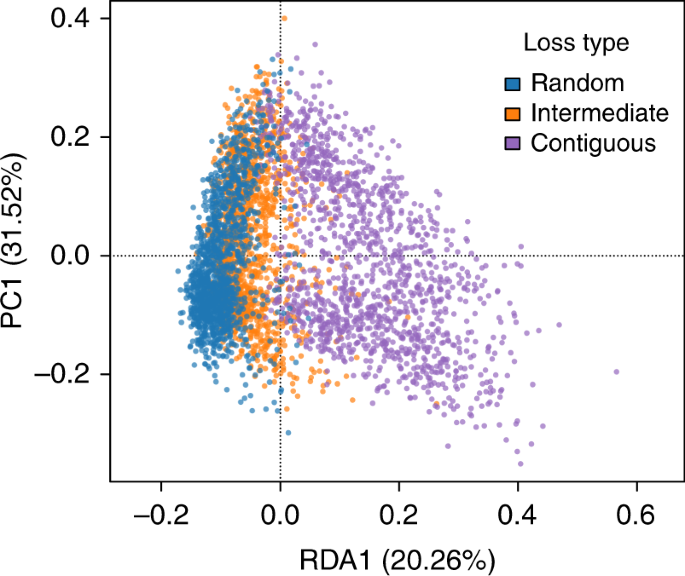
Abstract: "Habitat loss (HL) affects species and their interactions, ultimately altering community dynamics. Yet, a challenge for community ecology is to understand how communities with multiple interaction types—hybrid communities—respond to HL prior to species extinctions. To this end, we develop a model to investigate the response of hybrid terrestrial communities to two types of HL: random and contiguous. Our model reveals changes in stability—temporal variability in population abundances—that are dependent on the spatial configuration of HL. Our findings highlight that habitat area determines the variability of populations via changes in the distribution of species interaction strengths. The divergent responses of communities to random and contiguous HL result from different constraints imposed on individuals’ mobility, impacting diversity and network structure in the random case, and destabilising communities by increasing interaction strength in the contiguous case. Analysis of intermediate HL suggests a gradual transition between the two extreme cases."
Read More: https://www.nature.com/articles/s41467-019-10370-2
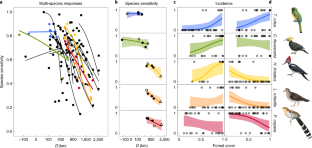
Abstract: "It is generally assumed that deforestation affects a species consistently across space, however populations near their geographic range edge may exist at their niche limits and therefore be more sensitive to disturbance. We found that both within and across Atlantic Forest bird species, populations are more sensitive to deforestation when near their range edge. In fact, the negative effects of deforestation on bird occurrences switched to positive in the range core (>829 km), in line with Ellenberg’s rule. We show that the proportion of populations at their range core and edge varies across Brazil, suggesting deforestation effects on communities, and hence the most appropriate conservation action, also vary geographically."
Read More: https://www.nature.com/articles/s41559-019-0889-z
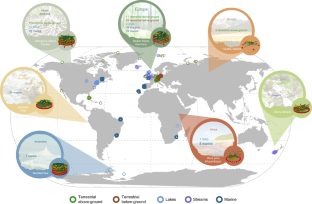
Abstract: "Predator–prey interactions in natural ecosystems generate complex food webs that have a simple universal body-size architecture where predators are systematically larger than their prey. Food-web theory shows that the highest predator–prey body-mass ratios found in natural food webs may be especially important because they create weak interactions with slow dynamics that stabilize communities against perturbations and maintain ecosystem functioning. Identifying these vital interactions in real communities typically requires arduous identification of interactions in complex food webs. Here, we overcome this obstacle by developing predator-trait models to predict average body-mass ratios based on a database comprising 290 food webs from freshwater, marine and terrestrial ecosystems across all continents. We analysed how species traits constrain body-size architecture by changing the slope of the predator–prey body-mass scaling. Across ecosystems, we found high body-mass ratios for predator groups with specific trait combinations including (1) small vertebrates and (2) large swimming or flying predators. Including the metabolic and movement types of predators increased the accuracy of predicting which species are engaged in high body-mass ratio interactions. We demonstrate that species traits explain striking patterns in the body-size architecture of natural food webs that underpin the stability and functioning of ecosystems, paving the way for community-level management of the most complex natural ecosystems."
Read More: https://www.nature.com/articles/s41559-019-0899-x
